Malaysia for Nylon magazine by Diane Vadino
Cross into Malaysia from Thailand by land and the first thing you notice is the quality of the highway. The palm trees and the tropical light filtering through them are the same, but the road— specifically the North-South Expressway, which runs long the country's western spine [WC?], south from the Thai border to Johor Bahru, which sits across the Johor Straits from Singapore—evens out. Signage indicating exits to the Cameron Highlands is prominent, uniform and, notably, in English—another reminder, like the tea plantations on the Highlands themselves, of Malaysia's pan-European colonial past, during which the English, Dutch and Portuguese all laid the future-relics of their time here, now manifest in language, lingering sensibilities and the crumbling buildings.
Malaysia is a country with a PR problem. Its beaches have long been touted as superior to Thailand's overrun equivalents; its diving sites off Borneo are some of the world's best, and it has religious sites and natural attractions to rival its regional neighbors. Nonetheless, the country has persistently failed to draw American visitors, in particular: We make up less than 5% of those entering the country, either by land or by air, flying into the thoroughly modern international airport in the capital of Kuala Lumpur and riding a train into the city that's a match for the Heathrow Express in efficiency and cleanliness—in all aspects except price; the fare is about 40% of the London equivalent. Whatever its benefits, though, a sound infrastructure is a difficult sell in a tourism brochure.
Unlike its Buddhist neighbors to the north, the country is predominantly Muslim, and it's this factor that many Malaysians blame. "They think we're all terrorists," one cab driver tells me, the "they" understood once he registers my American accent, and in Kuala Lumpur—or KL, as it's known to visitors and residents alike—we spot a man wandering through a temple on a Sunday morning in a white T-shirt with the words "fuck terrorist" in oversized black lettering. Whether "fuck" is being used as an adjective or a verb goes unknown. In any case, Malaysia's religiosity is a curious one: native Malays, who are—by constitutional definition—Muslim dominate, but there are also substantial Indian and Chinese populations, most of whose histories here extend several generations. The trinity is ubiquitous. What might feel like tokenism here is a mainstay of advertising and communications: From cell-phone ads to public notices celebrating Deepavali, the local name for the Hindu festival Diwali, viewers can count on a representative from each group on billboards and in print ads. Conflict between these groups can be difficult for an outsider to measure. "No, no strife," a guide tells me as we make our way from a Sikh temple to a Chinese tea room. "It is very calm between everyone." Still, the political parties are largely segregated by race, and, like those advertisements, a unifying message is voiced by three distinct throats: The ruling coalition, the National Front, counts its three biggest parties in the United Malays National Organization, the Malaysian Indian Congress, and the Malaysian Chinese Assocation. The multi-racial opposition, the Democratic Action Party, has yet to govern in the 51 years since modern Malaysia achieved independence from Britain.
A Chinese executive tells me that after several generations in Malaysia, he plans to leave Kuala Lumpur and immigrate [WC?] to Hong Kong. The Chinese, he says, are fundamentally different from the Malay majority. "We like to work hard," he says plainly, adding that in his view federal quota systems favor Malays. "It's too slow paced here." Leading us through KL's Central Market, our guide later explains that the favored shorthand for Malaysia's ethnic mix is not a melting pot but a salad, where each element remains distinct—specifically, the Malaysian rojak. Bahasa rojak —"salad language"—is the local term for the Malaysian-English version of Spanglish and was the subject of a widely maligned—and largely unsuccessful—government crackdown.
* * *
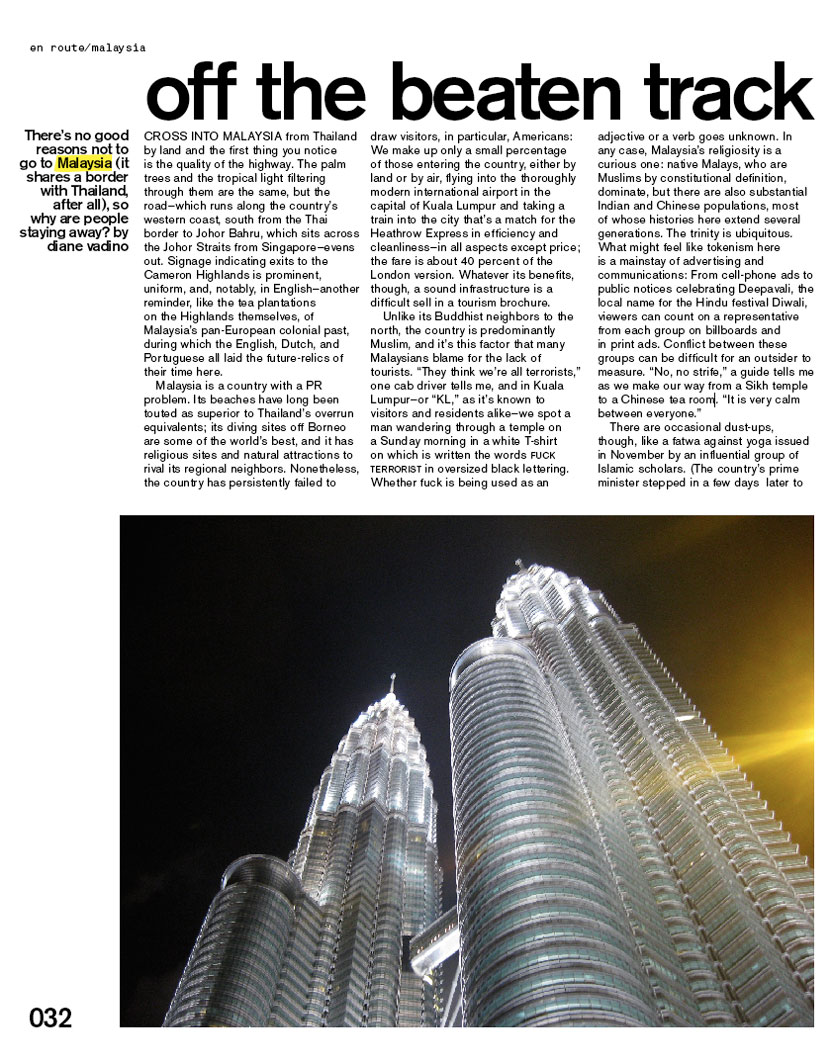
Kuala Lumpur's chief tourist sight other than its shopping malls is the Petronas Twin Towers, here usually referred to— jarringly, for New Yorkers—as the Twin Towers. Completed in 1998 and named for the oil and gas company whose headquarters take up half the available office space, the towers are supposed to signify Malaysia's emergence as a global player, rich with natural resources. They're gorgeous, with a curious, ornate design that's inspired by the geometrics of Islamic aesthetics. They don't seem particularly tall, though, and their six-year reign as the world's tallest buildings inspired a record-keeper's debate on how antennae and spires can, variously, count or not count toward a final height. (This is why the Petronas Towers and its spires topped the taller Sears Tower, which earns part of its stature from the discredited antenna.) Access to the observation bridge connecting the two towers requires foresight (sought-after timed tickets are required) and patience (guests are made to watch a corporate video extolling the towers' glory) and even walking across it, a measure of expectations-adjustment: After all, it's only located at the 41st floor; by contrast, the observation deck at the Empire State Building is on the 86th floor; the view from my room at the Shangri La hotel nearby seems nearly equivalent.
Jalan Petaling is Chinatown's market street, crowded with tourists and hustling vendors; those comparison-shopping for fake LeSportsac bags will find hours of entertainment. The nearby Central Market is a better bet for souvenir shopping, if not much else. Each is constituent in the "real" KL but the city's heart may be on clearer display at the Islamic Art Museum, several floors of textiles, architecture and objects like gorgeous ikat tunics and painstakingly detailed rugs. While the shopping malls echo Hong Kong and Singapore's in their ubiquity and Western sensibility, the exhibits here tie the country more closely to its neighbors across the Muslim world. It seems the better fit, less jarring and unmitigatedly European than the vision of Marc by Marc Jacobs and Topshop at the Pavillion mall.
* * *
Malaysia spans an ocean: KL sits on peninsular Malaysia to the west, while Malaysian Borneo is several hundred miles across the South China Sea. Though peninsular Malaysia's comparatively under-developed east coast beaches, like on Kapas Island, are deservedly becoming more popular, Borneo could hardly be regarded as much else than a tropical paradise, even in the rainy season: As our plane descends into Kota Kinabalu, the black streets shine with water, and Mount Kinabalu, the fourth-highest peak in southeast Asia, is hidden behind clouds.
There are traditional sights here, like the Monsopiad Cultural Village, a relic of Borneo's head-hunting past: A collection of skulls hang from the ceiling of one building, and our host warns us that the spirits are thick in the space. Mount Kinabalu is similarly regarded as a home for the island's spirits, a fact reflected in the mountain's name: "Akina-balu" is a local tribe's term for a spirit's resting place. This does nothing to dissuade those who climb the peak, a two-day trip that requires a guide and a permit request made up to six months in advance. Well-marked hiking trails snake around the mountain's base, through Kinabalu National Park. Thanks to elevation and dense vegetation, it's surprisingly cool and dark within the jungle, even at midday. It is better, of course, than infrastructure, and a rival for any other natural attraction in SE Asia—with the benefit of being sufficiently less crowded.
Divers are best dispatched to the island of Sipadan, but there are other dive sites closer to where I stay at the Tanjung Aru Resort & Spa. It is my favorite hotel in Malaysia, perfectly sited on the beach and purpose-built for enjoying a scattering of small nearby islands that double as parks. One evening, the sun emerges from behind clouds just moments before setting behind the sea; every structure in the hotel seems constructed to appreciate this view, especially the cluster of villas that make up the hotel's CHI Spa. The next morning, I head there for an early yoga class - the yoga pavilion is the best-located space on the property, practically suspended above the sea. On my way there, I see, for the first time, the peak of Mount Kinabalu above a layer of clouds. I wish for a second that I had a camera to record this elusive sight: By the time I come back this way again, it's gone.